
Every token you send to a cloud API is data you've handed to someone else. For some organizations, that's a risk that can't be managed with terms of service.
Cloud LLM subscriptions cost $20-$200 per user per month with per-token billing on top. At 10 users, that's $2,400-$24,000 per year - recurring, forever, with prices that only go up.
Your prompts, your data, your client information - all processed on shared infrastructure you don't control. Cloud providers' privacy policies aren't your privacy policies.
Cloud providers can change models, alter behavior, restrict access, or discontinue services at any time. Your workflows break when their priorities shift.
$9.4 million in HIPAA penalties since 2024. Twenty-two HHS investigations resulted in enforcement actions in a single year. Per-violation fines reach $2.19 million for willful neglect. Healthcare is not the only target; every regulated industry faces its own enforcement regime. Cloud AI creates the data transfer. Local hardware eliminates it.
DeepSeek V4-Flash and Llama 4 Scout running on hardware you own, on premises you control. No data leaves your premises. No exceptions.
Run as many prompts as you want, for as many users as you need, at zero marginal cost. The only cost after purchase is electricity.
You own the models outright. No vendor lock-in. No licensing fees. No usage restrictions. Run them, modify them, keep them forever.
Organizations where data sovereignty isn't a nice-to-have - it's a business requirement.
HIPAA / HITECH. Protected Health Information (PHI) processed through cloud LLMs creates a reportable disclosure event under 45 CFR §164.402. Local inference eliminates the cloud provider as a business associate entirely. No BAA required when data never leaves your network.
HIPAA-compliant AI for medical practices →Attorney-Client Privilege / ABA Model Rule 1.6. Client data sent to a cloud API is data disclosed to a third party. Courts have found privilege waived when confidential information is processed through systems outside the firm's control. Contract analysis, case research, and document review stay on-site or they don't stay privileged.
Local AI for law firms →ITAR / CUI / CMMC / CJIS. Controlled Unclassified Information and ITAR-regulated technical data cannot be processed on shared cloud infrastructure. CJIS Security Policy requires criminal justice information to remain within physically controlled environments. Cloud inference is structurally incompatible with these requirements.
ITAR-compliant AI hardware →Tribal Data Sovereignty / FERPA / State Privacy Laws. Tribal nations exercise inherent sovereignty over constituent data, enrollment records, and internal governance information. Cloud processing routes sovereign data through jurisdictions outside tribal authority. Local hardware keeps data within your jurisdiction, under your law.
Tribal data sovereignty AI →FERPA / IP Protection / Export Controls. Grant-funded research with proprietary data, pre-publication findings, and student records covered by FERPA cannot depend on cloud provider privacy policies. Intellectual property processed through third-party APIs becomes a provenance liability. Local inference keeps your research under your roof.
Local AI for research labs →Client Confidentiality / NDA Compliance. Consultancies processing client data through cloud LLMs are exposing that data to a third party's infrastructure, terms of service, and training pipeline. Your competitive advantage is confidentiality. Local hardware makes that confidentiality absolute, not contractual.
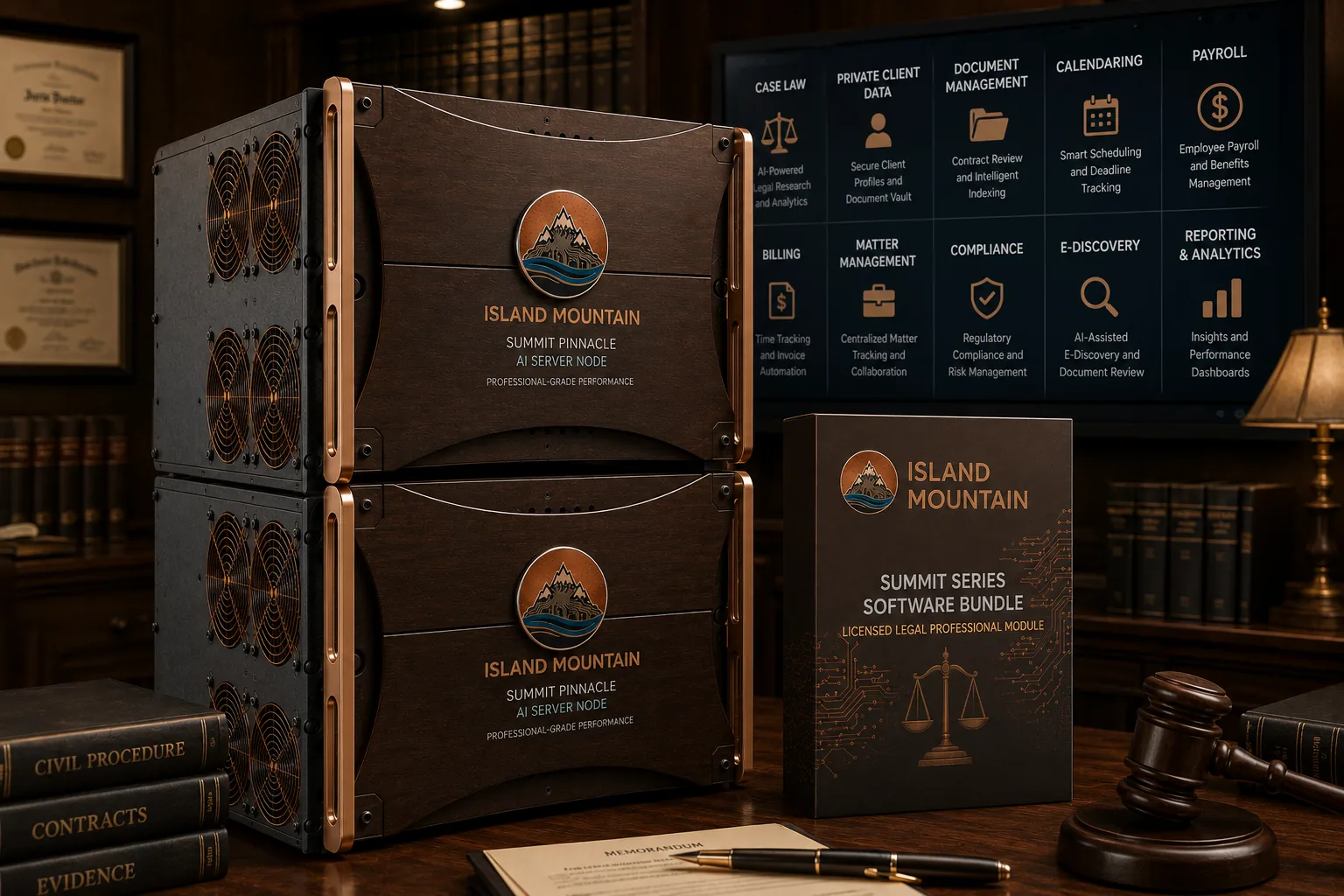
Summit Series: the hardware behind data sovereignty for regulated organizations
| Factor | Cloud LLM Subscription | Island Mountain (Local) |
|---|---|---|
| Monthly Cost (10 users) | $200-$2,000/month | $0 after purchase |
| Annual Cost (10 users) | $2,400-$24,000 | Electricity only (~$100-$200/mo) |
| Data Location | Cloud provider servers | Under your roof |
| Model Control | Provider decides | You decide |
| Per-Token Fees | $15-$60 per million tokens | None |
| Vendor Dependency | Complete | None |
| 3-Year Total (10 users) | $7,200-$72,000 | $75,000-$85,000 (one time) |
Ask three questions: Does your organization process data that cannot be sent to a third-party API? Is your team spending more than $1,500/month on cloud AI? Is your sector subject to data processing regulations (HIPAA, ITAR, CJIS, tribal sovereignty)? If any answer is yes, local hardware is worth evaluating. If all three are no, cloud AI is probably the better fit.
Your data leaves your network and is processed on shared infrastructure. It may be logged, stored, or used for model training. A provider breach exposes your data. HIPAA may classify the transmission as a reportable disclosure. Attorney-client privilege can be challenged. These are structural consequences of the cloud model. Local hardware eliminates the transmission entirely.
Yes, with honest caveats. The system arrives pre-configured and ready to run. Your IT person needs to rack it, connect power and network, and open a browser. We include 30 days of setup support. Ongoing maintenance is manageable - OS updates, occasional model updates through a graphical interface. If you have even one technical staff member or a part-time IT contractor, you can manage it.
We don't compete with Lambda Labs or Dell for enterprise SOC 2 contracts. We don't offer onsite support teams or 24/7 NOC monitoring. We don't have a compliance department or a procurement portal.
We also don't operate like a managed services provider. The MSP model charges $100-150K per year so you can have "one voice to talk to" on IT. The catch: that voice reads from a script, and actual expertise is locked behind subscription tiers. It's a pyramid built on the premise that accountability is a premium feature. We think that's backwards. Accountability comes standard when the people who built your system are the same people who pick up the phone.
What we build: boutique, personally-delivered AI hardware for organizations that value data privacy and personal service over vendor compliance paperwork. Every system is assembled, tested, and delivered by the person who answers your phone call: 1-801-609-1130.
If you need SOC 2 Type II and an SLA with 99.99% uptime guarantees, Lambda or Dell is your vendor. If you need a system that works, a person who picks up the phone (1-801-609-1130), and the confidence that your data never leaves your control - that's what we do.
Or call directly: 1-801-609-1130
We'd rather you know the tradeoffs before you buy than discover them after.
Cloud providers ship new models the day they're released. Local systems run open-source models that typically lag cloud releases by weeks or months. When OpenAI or Anthropic drops a new flagship, you won't have it on day one. You'll have it when the open-source community releases a comparable model and we validate it on your hardware.
Cloud scales on demand. Your local system has the GPUs it shipped with. If a future model requires more VRAM than your configuration provides, you'll need a GPU upgrade (a physical hardware swap, not a settings change). We offer an upgrade path, but it costs money and takes time.
The systems ship configured for inference, not training. Fine-tuning a model on your domain-specific data requires additional expertise, tooling, and potentially more VRAM than inference alone. We can consult on this, but it's not a plug-and-play feature at delivery.
Cloud providers handle patching, uptime monitoring, and hardware failures. With local hardware, your IT team is responsible for power, cooling, network connectivity, and OS-level security updates. We provide the first 30 days of support and a 1-year hardware warranty, but after that, this system lives in your server room and runs on your watch.
The Summit Base and Summit Ridge tiers run 70B-parameter models with context windows up to 128K tokens. That's strong for most tasks, but it's not the 1M token window available on V4-Flash (Summit Pinnacle tier only). If your workload requires full-codebase analysis or book-length document processing, the Summit Base tier won't cut it.
A dual-GPU local system serves a team of 5-15 users well. It's not a replacement for enterprise cloud infrastructure serving hundreds of concurrent users. If you need to serve 100+ simultaneous heavy inference requests, local hardware at this price point isn't the right architecture.